Gynecology Marketing: How to Build Trust and Grow Your OB/GYN Practice
Gynecology is not like marketing a dental cleaning or an urgent care visit. When a woman chooses an OB/GYN, she is making one of the most personal healthcare decisions of her life — selecting someone she will trust with reproductive health, pregnancy, menopause, and everything in between. That relationship can span decades. Which means gynecology marketing is not really about acquiring clicks. It is about earning confidence before patients ever step into your office.
The practices growing fastest in 2026 understand this distinction. They are not simply running ads. They are building a presence — digital, educational, and relational — that makes patients feel certain they have found the right physician. This guide walks through the strategies that actually move the needle.
Why Trust Is the Foundation of Gynecology Marketing
!Female pelvic anatomy cross-section in Netter illustration style

Women's health is intimate. Patients do not shop for an OB/GYN the way they might choose a restaurant. They ask friends. They read reviews. They scan your website and social media to get a sense of who you are before they ever call your front desk.
A 2024 survey from Healthgrades found that 66% of women consider online reviews the most important factor when choosing a new gynecologist — ranking above location and even insurance acceptance for many. Separate data from PatientGain shows that practices with fewer than ten recent reviews on Google lose a meaningful share of prospective patients to competitors with stronger review profiles, even when clinical outcomes are comparable.
What patients are ultimately looking for in those reviews — and on your website, your social channels, and in your patient education materials — is evidence that you communicate clearly, treat people with dignity, and can be trusted to explain complex medical realities in accessible terms. The practices that get this right attract patients. The ones that do not, even with excellent clinicians, struggle to grow.
Build a Website That Works as a First Appointment
Your website is often the first substantive interaction a potential patient has with your practice. Most practices underestimate how much work it needs to do. It is not enough to list your services and hours. The site needs to make visitors feel welcomed, informed, and confident enough to book.
A few things that directly affect this: provider bios should go beyond credentials to convey personality and philosophy. Photos of your actual office and staff outperform stock photography — patients are trying to picture themselves in the waiting room. Service pages for topics like prenatal care, endometriosis, PCOS, and perimenopause should be thorough enough to demonstrate genuine expertise rather than just naming the condition.
Speed and mobile responsiveness are non-negotiable. The majority of health-related searches happen on mobile, and a slow or difficult-to-navigate site will send patients elsewhere regardless of how impressive your credentials are.
From an SEO standpoint, localized content matters more than most practices realize. Pages optimized for queries like "OB/GYN in [city]" or "gynecologist near [neighborhood]" attract patients at the exact moment they are ready to book. A well-structured blog — addressing the questions patients are actively searching for, from first prenatal visit timelines to what to expect during a colposcopy — builds organic search traffic over time while positioning your physicians as credible authorities.
Reputation Management Is Not Optional
In gynecology, word of mouth has simply moved online. Patients who previously asked a friend for a referral now consult Google, Healthgrades, Yelp, and Zocdoc. Practices that ignore this dynamic cede enormous competitive ground.
Actively soliciting reviews from satisfied patients — through automated post-visit emails or text messages — should be a standard part of your patient communication workflow. Most patients who had a positive experience will leave a review if asked clearly and promptly; very few will do so unprompted. Responding to reviews, both positive and negative, signals to prospective patients that the practice is attentive and professional.
Negative reviews warrant particular care. A measured, empathetic public response that does not disclose protected health information can actually strengthen a practice's reputation by showing how it handles difficult situations. The goal is never to argue but to demonstrate character.
Patient Education as a Marketing Strategy
!Physician using anatomical illustration to explain female anatomy to a patient
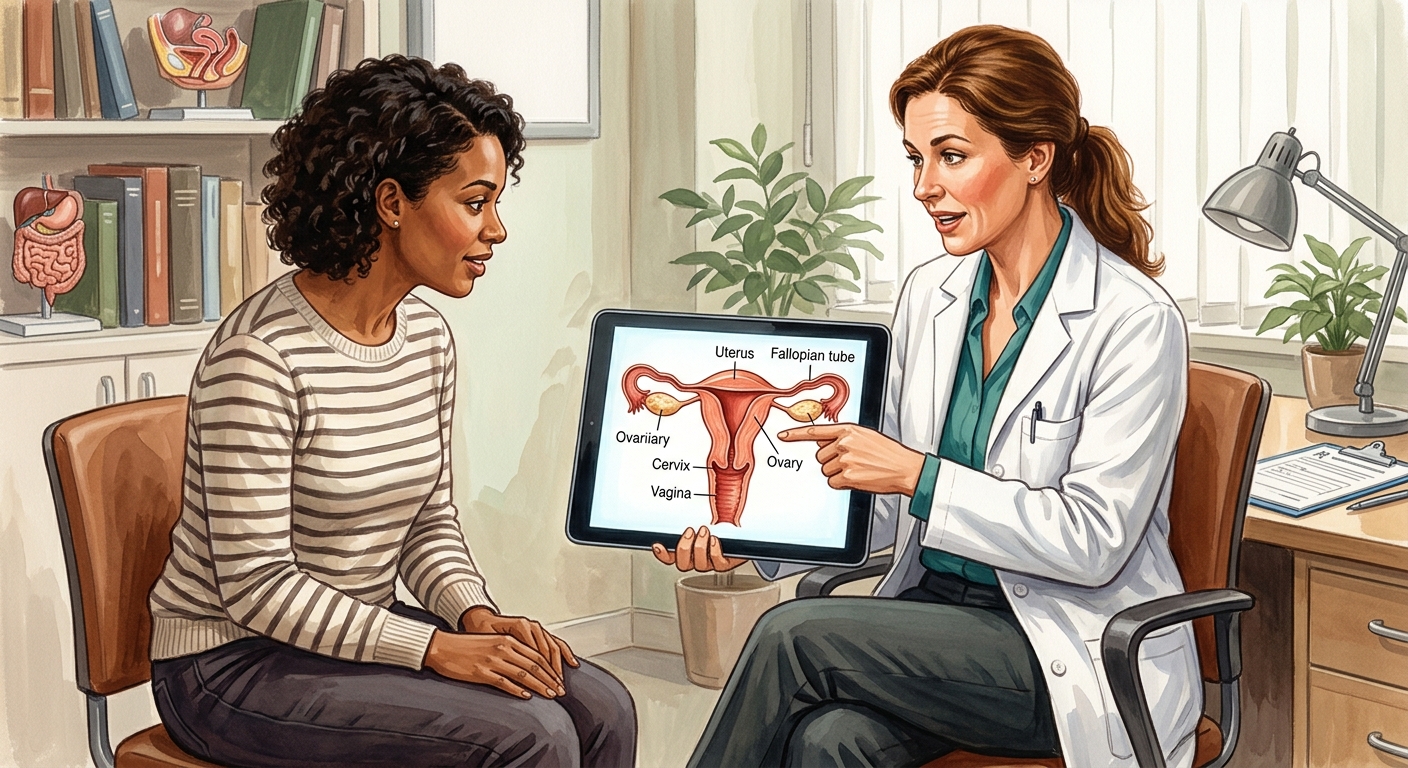
Here is an insight most gynecology marketing guides overlook: how well you educate patients directly affects how much they trust you — and how likely they are to refer others.
Patients who leave appointments genuinely understanding their diagnosis, their anatomy, and their treatment options feel taken care of in a way that generic pleasant interactions do not replicate. Educational content that extends that experience beyond the office visit — through blog posts, social media, email newsletters, or printable patient handouts — creates ongoing touchpoints that reinforce confidence in your practice.
This is also where visual communication becomes strategically important. Gynecology involves anatomy and procedures that many patients find difficult to conceptualize from verbal explanations alone. Clear anatomical illustrations — of the uterus during fibroids, the cervix during a colposcopy procedure, or pelvic floor anatomy — dramatically improve patient comprehension. When patients understand what is happening in their own bodies, anxiety decreases and engagement increases.
Practices that invest in high-quality anatomical visuals for patient education materials, website content, and social posts communicate something important: that they take patient understanding seriously. It differentiates them from practices that rely on generic stock imagery or walls of text.
This is where tools like Natomy AI become genuinely useful. Natomy transforms clinical photos and descriptions into professional-grade medical illustrations — Netter-quality anatomical visuals that can be used in patient education materials, website graphics, surgical consent documentation, and social content. For a gynecology practice producing regular educational content, it eliminates the cost and lead time of commissioning custom illustrations while maintaining the kind of quality that reinforces clinical credibility.
Social Media That Actually Connects
Social media for OB/GYN practices is most effective when it reflects the same care and communication that happens in the exam room. Content that performs well is not promotional — it is educational, reassuring, and occasionally humanizing.
Posts that explain common but under-discussed topics — what a Pap smear schedule actually looks like after 30, what perimenopause symptoms are typical, when to see a specialist about period irregularities — earn real engagement from women who recognize that someone is addressing their questions directly. Short videos featuring your physicians explaining these topics perform especially well on Instagram and YouTube, where women actively search for health guidance.
Behind-the-scenes content — introducing staff, showing your office, celebrating milestones — helps prospective patients feel familiar with your practice before their first visit. This familiarity lowers the psychological barrier to booking.
Consistent posting matters more than high production value. A practice that publishes two to three pieces of genuinely useful content per week will outperform one with occasional polished campaigns.
Referral Networks and Community Presence
Digital strategies do not replace the value of being embedded in your medical community. Relationships with primary care physicians, pediatricians, fertility specialists, and certified nurse midwives generate a steady stream of referred patients who arrive with an existing level of trust.
Formalizing these relationships — through mutual referral agreements, co-hosted patient education events, or shared educational resources — can meaningfully grow patient volume beyond what digital marketing alone achieves. Similarly, involvement in local health fairs, hospital system partnerships, and employer wellness programs builds brand visibility among the specific demographics your practice serves.
Making the Numbers Work: Paid Advertising for OB/GYN
Organic strategies build long-term authority. Paid advertising fills the near-term pipeline. Both matter.
Google Ads targeting high-intent searches — "OB/GYN accepting new patients," "prenatal care [city]," "endometriosis specialist near me" — deliver measurable patient volume with relatively low cost-per-acquisition compared to most specialties, because competition in paid search for gynecology remains modest in many markets. Healthcare practitioners typically allocate 7–10% of revenue to marketing; for a growing OB/GYN practice, directing a meaningful portion of that toward paid search makes sense.
Facebook and Instagram advertising allows targeting by demographics that align closely with your patient population, particularly for condition-specific campaigns around fertility, menopause, or LGBTQ-inclusive care. Creative that centers on patient stories, educational content, or provider introductions outperforms straightforward promotional ads because it aligns with how women actually engage with health content on social media.
Putting It Together
Gynecology marketing works when it is consistent with the quality of care your practice delivers. Patients who find you through a well-written blog post, read thoughtful reviews, watch your physician explain endometriosis on a short video, and then arrive for a first appointment where a clear anatomical diagram is used to explain their diagnosis — those patients become loyal, referring patients. The marketing and the care experience reinforce each other.
The practices that are growing in 2026 are not those with the biggest advertising budgets. They are the ones that have invested in clear communication at every stage of the patient relationship — before, during, and after the visit.
If you want to improve the quality and consistency of your patient education visuals — whether for your website, social content, or in-office materials — Natomy AI was built for exactly that. Try it at natomy.com.
Ready to create your own medical illustrations?
Upload a clinical photo and generate a professional illustration in seconds.
Try for Free →